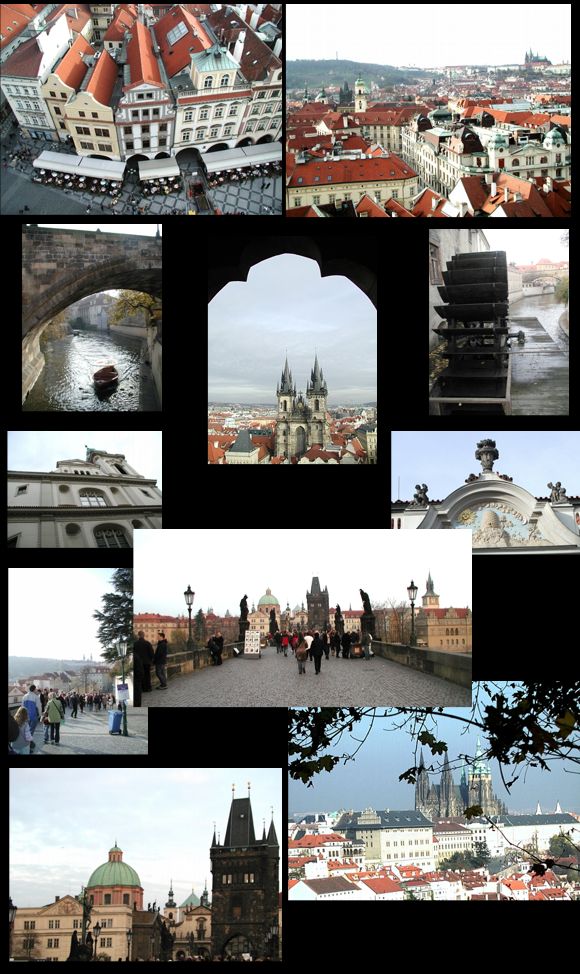
This is a whole day tour ( about 5-8 hours )
that can be either a walking tour or a combination of walking
and driving.
The guide will show you the interiors of the baroque libraries, the
collection of the unique Loreto treasury, the Old Royal Palace
and the Cathedral in the Prague Castle area, the old Jewish
Quarter area with its famous Old New Synagogue and the Old
Jewish Cemetery and the baroque churches.
You can start any time you like.
It is possible to split this tour into two half day /4 hour/ tours.
5-8 HOUR TOUR
It is possible to split this tour into two days as two half-day
4 hour tours.
GUIDE and VEHICLE
or GUIDE ONLY
Tickets to attractions are not included in the tour price.
LORETO TREASURY
The Prague Loreto is a remarkable Baroque historic monument, a place of pilgrimage with captivating history. The expansive decorative frontal façade with a clock tower, from which the Loreto carillon tunes may be heard every hour, shall certainly not go unnoticed by any local or foreign visitor passing here on his or her way to the Prague Castle. It would, however, be a great pity to enjoy only this picturesque view opening before us from the terrace of the Czernin Palace. Those who descend as far as the Loreto Square and pass through the Loreto gate will be pleasantly surprised by the place of pilgrimage disposition. We are convinced they will appreciate everything of interest that is to be seen here.
Only when we walk through the frontal building, we shall find ourselves next to the “Loreto” itself – that is the Loreto Chapel proper, the so called Santa Casa. It is a copy of the ”Holy House” of Nazareth worshipped in the Italian Loreto as a place in which the Miracle of Incarnation had occurred (here, archangel Gabriel announced to the Virgin Mary she would conceive and become the mother of Jesus, the son of God, marking his Incarnation). Lavishly decorated with reliefs on the outside after the Italian prototypes, is a spiritual centre of the entire place of pilgrimage. Standing freely in the courtyard area, it is surrounded by a storeyed cloister with corner chapels.
On the axis of the courtyard, beyond the Loreto Chapel may be viewed the pilgrimage Church of the Nativity of Our Lord. It is one of the most impressive surviving Rococo interiors in Prague. Here, Baroque organs resound every Saturday afternoon during the regular concerts organised for visitors. The music indeed accompanies those who come to Loreto throughout their whole visit – every hour, the entire building comes alive with the tunes of a Czech Marian hymn “ Tisíckrát pozdravujeme tebe” /Hail Mary Thousand Times/ produced by the carillon mechanism, and during feasts, the local organists play, on the carillon keyboard, the spiritual music compositions (the programme is regularly published - sorry, available only in Czech version).
At the end of the tour, the visitors come to the treasury, where the considerable part of the famous Loreto treasure is exhibited. Beside the St. Vitus Cathedral treasure, it is the most valuable ecclesiastical treasure in the Czech Republic. It is dominated by the Diamond monstrance, also known as the Prague Sun created at the end of the seventeenth century in Vienna with the use of unbelievable 6 222 diamonds. Since the foundation of Loreta, the Capuchin Brothers (whose monastery with the Church of the Holy Angel Virgin is situated in the neighbourhood) have taken care of Loreta and of the pilgrims.
STRAHOV MONASTERY - BAROQUE LIBRARY
THEOLOGICAL HALL
The Theological Hall was built under Abbot Jeroným Hirnhaim (1671-1679). The architect was a Prague burgher of Italian origin, Giovanni Domennico Orsi, whose Italian school is evident in the stucco cartouches. The Baroque concept of the library is demonstrated by the shelves; unlike the Romanesque treasury system or the Gothic desk system, the books were stored upright. Above the shelves, there are gilded wooded carved decorations with wooden cartouches. Fifty years later, to celebrate the 100th anniversary of the translation of St Norbert's relics (1727), the hall was extended by several metres. It was then decorated with frescoes by the Strahov Premonstratensian and painter Siard Nosecký. Symbolically, and based on quotations from the Bible (mainly Proverbs) and in part from the philosophical tracts of the hall's founder, Abbot Hirnhaim, he presented the true wisdom we acquire through piety, fear of God. A number of globes (both astronomical and terrestrial) line both sides of the Theological Hall. Some of them come from the workshop of the Rotterdam-based family Blaeu, which specialized in manufacturing maps, atlases, and globes over several generations in the 16th and 17th centuries.
Over 18,000 volumes are stored in the Theological Hall. The name of the hall comes from the content of these works. The northern wall contains nothing but different editions of the Bible or parts of the Bible in many languages.
In 1993 and 1994, the interior was restored.
The Strahov Cabinet of Curiosities was bought for Strahov out of the estate of Karel Jan Erben in 1798. Cabinets of curiosities (Wunderkammer) are the direct predecessors of modern museums. Curiosities Right at the entrance to the historical part are natural science collections, mainly with sea fauna, complemented with collections of insects, minerals, and wax replicas of fruit. Here a true object of curiosity is the prepared remains of the bird Dodo (Dodo ineptus), now extinct. A wire shirt from the 12th century and a breastplate from the 17th century hang between the display units. The display units contain 'archaeological' collections: ceramics, handcuffs, Hussite peasant weapons. In front of the entrance to the connecting passage there is a pedigree chart of Premonstratensian monasteries for the period from 1120 to 1727.
In the connecting passage, we can see a number of volumes, mainly related to medicine, law, alchemy, and metallurgy. At the end of the corridor, above the door, there is a portrait of Abbot Kryšpín Fuck, who made the upper flow of the Vltava navigable all the way to Prague just before the mid-17th century.
A facsimile of the Strahov Evangeliary is presented on a special stand. This codex, which is older than the Czech state, is dated 860-865 and comes from Trier; in around 1100 it was still the property of the local monastery of St Martin. Between 980 and 985 four full-page illustrations of the evangelists were bound into the codex.
PHILOSOPHICAL HALL
In the final quarter of the 18th century, Abbot Václav Mayer decided to build new library space for the numerous additions to the library. To this end, he had the current Philosophical Hall built on the site of a granary by Jan Ignác Palliardi, an Italian architect naturalized in Bohemia. The façade was built in 1783, but after the advantageous purchase of a walnut interior for the library, relocated from the abolished Premonstratensian monastery in Louka by Znojmo, he adapted the dimensions of the future hall to the size of the shelves. The interior was installed in 1794-1797 by its original designer, Jan Lahofer of Tasovice, and modified to an Early Classicist Style. The amazing size of the hall (length: 32 m, width: 22 m, height: 14 m) is compounded by the monumental ceiling fresco by Viennese painter Anton Maulbertsch, painted over six months in 1794 with the help of just one assistant. The highest rows of books are only accessible from the gallery; hidden spiral staircases, masked with false book spines, lead up to the corners of the gallery.
BooksThe fresco 'Intellectual Progress of Mankind' is a concise depiction of developments in science and religion, their mutual impact on each other, and quests for knowledge from the oldest times until the time the hall was built.
Numerous visits by important people are recorded in the oldest visitors book first used in 1792. Women were initially only allowed to enter the library sporadically because of the imposition of monastic seclusion. One of the first was, surprisingly, Lady Emma Hamilton, who visited the library in 1800 with her husband, the British archaeologist and statesman Sir William Hamilton, and her lover, the victor of the Battle of Trafalgar, Admiral Lord Horatio Nelson. Another significant woman to enter the library, on 17 June 1812, was the Austrian Princess and wife of Napoleon Bonaparte Marie Louise. In the autumn of the same year, she sent Strahov Library more books, a Viennese set of porcelain, and, most significantly, a four-volume work on the first Louvre museum. When this exclusive publication had been completed, Napoleon is said to have ordered the whole print run to be destroyed, and kept just three or four complete series. He was afraid that his reputation would be ruined by the fact that the work listed the origin of a whole number of exhibits, looted in the main in Italy. This gift was stored in a special high cabinet overlooking the other furniture in the hall.
In addition to philosophy, which originally included all the sciences, we can also find works from other disciplines which were taught at universities in the scope of courses on philosophy: astronomy, mathematics, history, philology, etc. There are more than 42,000 volumes in this hall.
"The Old Town Bridge Tower on one side of the Charles Bridge, was
built to be "one of the most beautiful in Europe". In a city with
over a "hundred towers" this was no simple task. At the same time
the bridge tower was meant to serve a deeper purpose than simply
being part of the Gothic mosaic: Charles IV and architect Peter
Parler designed the tower to be a mystical edifice, a "speaking
stone" full of hidden meaning and symbols which would communicate
to those who could understand, those who bore the secret "keyes".
The code was provided by the mystical builders of the
cathedrals..."
"Once a year only, on the day of the Summer Solstice June 21st,
Prague´s St. Vitus Cathedral is the site of a most mysterious
happening which is visible from the Old Town Bridge Tower. As it
sets, the sun´s rays fall upon the cathedral´s presbyterium,
shining precisely on the area where Czech kings and saints lie
buried. This effect, which has no equal in Gothic Europe,
reflects Charles IV´s deep understanding of the city´s urban lay-
out, accomplished by his architects..."
"One of the most delightful elements of Old Prague are house
emblems or signs, which prove just how naturally elements of the
Cabala, Christian mysticism, Astrology and Magic, formed a part
of citizens´lives in days now long forgotten. In terms of house
signs Prague has no rival, in neither London, Munich, Amsterdam
or Paris. Numbers, letters, crosses, angels, alchemistic elements
and objects, symbolic animals and tools of healing, all existed
in the heart of Prague for centuries."
Johannes Kepler´s Prague stay was instrumental for modern
astronomy, comparing Tycho Brahe´s observations with his own,
Kepler was able to write thirty papers in the court of Rudolph
II, including the classic Astronomia Nova in 1609 and Dioptrica,
two years later. He was one of the first to observe solar
discrepancies on the sun, and in the words of Carl Sagan "tore
the very laws from Nature" , concerning the movement of planets,
an understanding which remains the foundation for modern
astronomy and space travel. Kepler´s third law, which deals with
size of planetary orbits and length of time it takes a planet to
orbit around the sun, applies equally to Uranus, Neptune, and
Pluto, celestial bodies which were not known in his day. Kepler
resided in several places in Prague, but spent most of his time
at the house At the French Crown, where he lived for five years,
until the death of emperor Rudolph II in 1612. Kepler´s
observatory was found in the Clementinum, which was across the
street.
It is said that Johannes Kepler didn´t like astrology but the
opposite is true. Kepler took astrology very seriously, creating
horoscopes for himslef, Emepror Rudolph II, and the emperor´s
brother Matthias. Kepler gained further renown by working out
General Wallenstein´s horoscope, which shockingly predicted the
nobleman´s encrouching death.
During his almost 12 year residency in Prague Kepler kept ties
with many Czech noblemen who were members of the Brotherhood of
the Rose and the Cross. While he met Tadeas Hajek a few times,
Kepler had longer standing connections with Vaclav Budovec
(executed in 1621 on the Old Town Square), Krystof Harant (the
nobleman, composer, writer , executed in 1621) and Jan Jessenius
(anatomist, professor at Prague University, executed in 1621),
who shared Kepler´s magical view of the world, a view based on
Pythagorean ideas on the harmony of the universe and God as the
grand mover of events.
Kepler worked without the aid of a telescope, though Galieleo
lent him one for a month in 1610, professional envy and
competitiveness prevented Galileo from lending any of his rare
prototypes for a longer period . In spite of this disadvantage,
Kepler´s discoveries in physical astronomy, especially the
movements of the planets, carry the mark of genius.
text - Jiri Kuchar - "Praha esotericka"