Medieval Gothic Town Protected By UNESCO. Ossuary With The Bizarre Bones Chandelier. Silver 17th Century Mine. Unique Cathedral of St. Barbora. Italian Gothic Court Center Of Coins Minting. Movies The Grimms Brothers, The Omen.
Order Tour Code: C E1
Tour availability:
<bgsound src="bgmusic.mid" loop="1">
Spanish text:
We will show you this a UNESCO protected town
that was the second most important one after
Prague due to silver mines in the middle ages. Don´t
miss the bizarre ossuary (charnel house), where
the bones of 40,000 people were formed into
pyramides, a chandelier and a coat of arms.
It is possible to add a 1-hour supplement to the trip
by visiting the medieval silver mine.
5-6 HOUR ROUND TRIP
It is possible to add a 1-hour supplement to the tour by visiting the medieval silver mine.
This supplement is not recommended for
claustrophic individuals or those who are overweight.
The trip to Kutna Hora town, Sedlec Ossuary and Silver Mine is a 6 hour round trip.
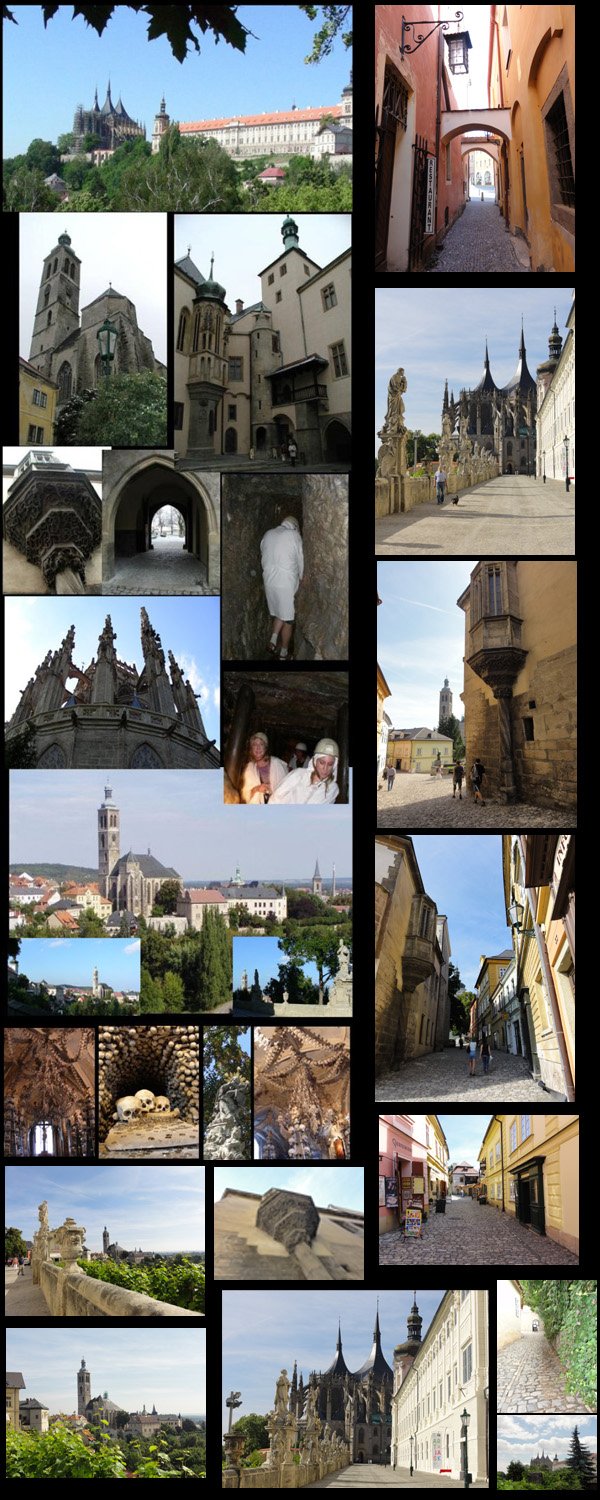
Kutna Hora is a superb example of medieval architecture.
In the Middle ages Kutna Hora was the second most important town after Prague due to silver mines.
The core of the town consists entirely of Gothic and Baroque buildings and it is the unique collection of around 457 objects on an area covering 60 hectares.Of the municipal buildings the Italian Court is the most outstanding.
It became the mint of the Czech lands. Minting in Kutna Hora ceased in 1726.
You can see there St. Wenceslas and Vladislav Chapel, the council chamber and museum of coins.
One of the best examples of Bohemian High Gothic is the Cathedral of St. Barbora, the patroness of miners, began around 1380 and finished in the 16th century. It is the landmark of the city panorama.
Also worth to see is the Ossuary of Sedlec Monastery, 1km behind the town. There are about 40.000,- human bones stored in the crypt, from which the blind monk made the pyramides in the 15th century.
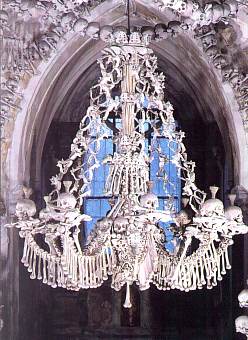
The monastery was bought by the Schwarzenberk family and they established the tobacco factory there and one of their artist, Mr. Rint, changed the ossuary into a very bizarre place, he made from the bones the chandelier the coat of arms of the Schwarzenberks and the altar.
This is memento mori, symbol of passing character of life.
HISTORY OF THE OSSUARY IN SEDLEC
A cistercian monastery was founded near Kutna Hora (that didn´t exist that time) in the year 1142. One of the principal tasks of the monks was the cultivation of the grounds and lands around the monastery. In 1278 King Otakar II of Bohemia sent Henry, the abbot of Sedlec , on a diplomatic mission to the Holy Land. When leaving Jerusalem Henry took with him a handful of earth from Golgotha which he sprinkled over the cemetery of Sedlec monastery, consequently the cemetery became famous, not only in Bohemia but also throughout Central Europe and many wealthy people desired to be buried here.The burial ground was enlarged during the epidemics of plague in the 14 th century (e.g.in 1318 about 30 000 people were buried here) and also during the Hussite wars in first quarter of the 15 th. century.
After 1400 one of the abbots had a church of All -Saints erected in Gothic style in the middle of the cemetery and under it a chapel destined for the deposition of bones from abolished graves, a task which was begun by a half blind Cistercian monk after the year 1511. The charnel-house was remodelled in Czech Baroque style between 1703 - I710 by the famous Czech architect, of the Italian origin ,Jan Blazej SANTINI-Aichl. The present arrangement of the bones dates from 1870 and is the work of a Czech wood-carver, František RINT (you can see his name, put together from bones, on the right-hand wall over the last bench).
Our ossuary contains the remains of about 40 000 people. The largest collections of bones are arranged in the form of bells in the four corners of the chapel.
The most interesting creations by Master Rint are the chandelier in the centre of the nave, containing all the bones of the human body , two monstrances beside the main altar and the coat-of arms of the Schwarzenberg noble family on the left-hand side of the chapel.
Its foundation is bounded with the story of abbot Heidenreich, who went to Jerusalem in 13th century. From there he brought a bit of saint soil. During the ceremony he scaterred the soil on the local cemetery which turned to a place full of miracles. Sedlec then was sought by many pilgrims and christians from Poland, Bavaria and Belgium, who wanted to be burried there. Being burried in Sedlec ment being closer to the ressurection, so it is normal that many people were concerned in being burried there. Thirty thousands victims of black death and many hussites were added to the local corpses. So there had been more than enought material for the decoration.
Since the 16th Century bones were used as a decoration, but the final appearence was made by baroque architect Jan Blazej Santini. He took advantage of the lay-out of the building and he put a stress on its allegoric meaning. He placed crowns symbolising God´s kingdom over pyramids consisting of more than 40thousand bones. There are four obelisks that mean the same as four beams of light in the dark night – a hope. It seems as a hardly believable story today. To speak about a hope in the cemetery is absurd. However, the Sedlec cemetery is a place, where the miracle is awaited and the whole building is meant as an allegory of this miracle. You may find a chapel symbolising victory over the death placed over the charnel house, so corpses below are just waiting as they rise up from the dead. The sacred soil brought there by abbot Heidenreich was from the place where Jesus was crucified. As Christians believe, Jesus put an end to the death, so being near to the sacred soil meant the same as being near to Christ and thus being near to redemption.
When looking on the festoonery of skulls and shins one would hardly imagine how the redemption would look like. Would a foot from the lustre get to its huckle hanging on the ceiling? Even in the medieval and baroque era people thought in that way, so rich burghers were rather burried as a whole corpse. Only poor and unknown corpses were used as a decoration. Images of ressurected dead ones varied, but they had one thing in common – they were just fables and allegories. The ressurection itself was in full competence of Christ.
The last changes of the charnel house were done by wood-carver Frantisek Rint in the 19th Century. He is an author of the bony lustre, Schwarzenberg coat of arms and other changes. He filled walls and vaults with skulls with crossbones and he hanged some bones on display. His works in charnel house are one of the most elaborate ones but also they are somehow incompatible with the overall symbolics of the building. Symbolics of death totally overweighted the former symbolics connected with the chapell above. It seems as if the Christmas were celebrated in the cemetery after Rint´s changes. But the fact that the ressurection is being celebrated in Kostnice remains.
THE CATHEDRAL OF ST. BARBORA
The church was built outside the town walls, on land owned by the Prague Chapter, outside the range of the Sedlec Monastery, and was dedicated to St. Barbara, the miners' patron saint. Founded in 1388, most of the construction was financed by the miners themselves. The impressive structure which, according to some historic sources, had been planned at twice its current length, was erected in stages, and depended to a large extent on the prosperity of the local mines. All sorts of events interrupted the construction several times and more than 500 years elapsed between the start and the definitive completion of the project in 1905.
Kutna Hora had always wanted to be a match for Prague and it was certainly not by mere coincidence that Prague builders and architects had been sent for to take part in the construction. Johann Parler, son of Peter Parler, the builder of St. Vitus's Cathedral in Prague, was the first designer of St. Barbara's. Hence the correspondences between the Kutna Hora church and the cathedral in Prague. As silver mining gradually declined, the financial resources slowly dried out, and a provisional wall terminating the church was built in 1558.
In 1626, the church was handed over to the Jesuits and was largely Barocised. The unique structure then remained unfinished for over 300 years. In 1884, the town authorities, inspired by the local archeological society, Vocel, decided that construction should be resumed. The project was definitively completed in 1905. The architecture of St. Barbara's is a textbook example of the development of Gothic architecture in Bohemia.
Church of Saint Barbara stands there as a kind of defiance. As a decoration above the left entrance you may see a miner who has turned his back towards the town and holds his clothes in a way that he is actually showing his bottom... That miner was placed there when enterpreneurs of Kutná Hora rebelled against a king, but it can be interpreted as a universal symbol. Barbara had to challenge nearby Sedlec Church and also churches in Prague.
Construction of the church started in 1388 and its first architect was Jan Parléř. In the beginning, the construction processed very quickly. The church was built from sandstone that had been mined in the nearby quarries. The sandstone contains many seashells that you can see even today. Only four years after the construction begun 15 altars were admitted to holy orders and to every altar a special priest was ordered. Till hussite wars the building raised to half of its today´s height, but it remained in that height till 1547, when the middle three-body ceiling was finished. It is neccesary to say that until this moment it rained into the church. Kutná Hora was even runnig out of silver and thus miners decided to finish the works on the church. In the original project the church had to be two times longer and this assymetry seems very funny when you are inside of the church. And it is more funny even when you know, how are miners of Kutná Hora proud on the church of Saint Barbara.
Works on the church were renewed in 1905, which means that Barbara waited for its finishing more than 500 years. But for all the times people met there for prayers to their patron. They prayed even under the earth surface, mainly during crush-ins. Barbara helped miners in seemingly helpless situations. People of Kutná Hora told thousands stories about her help. She opened a hard rock, she enlightened the darkness of the mine or she just showed the right way out of the crush-in. To have a church dedicated to her meant ensuring her support when being in the mine... or at least to ensure hope. Anyway, you may pray as well... if you succesfully finished your visit to the mine, you may thank in your prayer and if you are about to visit it, prayer would be helpful. (one never knows what will happen)
However, the most amazing scenes of Saint Barbara Church are hidden before visitor´s eyes. Churches weren´t built only for our admiration, but mainly they are dedicated to God and the strangest objects are placed highly on the top of the church. Using binoculars you may admire fantastic fauna, that is comprising of chimaeras, bats, daemons, harpias, frogs or even winged rams. You may find a monkey with an orange on one of the south pillars. It is the first plastic depiction of this fruit in Bohemia. There is a pleasurous atmosphere made by coloured light of church windows and by perfect acoustics. Organ concerts are organised there, as well as regular masses are taking place in the Church of Saint Barbara
THE MINTING ITALIAN COURT
For centuries Vlassky Dvur (in English "Italian Court") was the center of the state's economic power. There was a royal mint and the seat of the sovereign during his stays in the town of Kutna Hora. According to historical documents, Italian Court was established at the end of the 13th century in corresponding to the development of the town of Kutna Hora. The function of Italian Court as a town fortress is the result of the need for the secure depositing of mined silver ore. The transformation of the fortress into a mint had taken place by the end of the 1330's, along with the construction of both public and private premises. The name Vlassky Dvur appears for the first time in the historical references of 1401.
This period witnessed another result of construction activities: the erection of the royal palace and its chapel. This palace is thought to be related to the then growing interest of Wenceslas IV in the town of Kutna Hora. The king did not come to Kutna Hora during the first 20 years of his reign, but around 1400 he began to visit the town regularly, even for long periods of time. Important meetings among statesmen took place here (the meeting of Wenceslas IV. and his brother Sigismund during the Christmas of 1401, the signing of the Decree of Kutná Hora in 1409, etc.).
The mint was abolished in 1727, followed by the office of the highest mint master in 1783. Following the fire of 1770, this building served as the Town Hall, and during the Napoleonic wars as a military hospital. In 1819 there were plans to transform the mint into a criminal court and prison. Since 1881, part of the building has served as an elementary school. In the same year, the town council announced a competition for the reconstruction of Vlassky Dvur. The current appearance of the mint is the result of the transformations that took place between 1893 and 1897. The construction engineer was a man named Ludwig Labler, who took part in the reconstruction of St. Barbara's cathedral as well as other historical building in Kutna Hora.
THE TOWN KUTNA HORA
Kutna Hora is located approximately 60 kilometres east of Prague. Because of its exceptional beauty, the town is referred to as a treasury and the jewel of the country. In the Middle Ages it owed its wealth to silver mining. It is small wonder then that the dominant feature of Kutna Hora is a late Gothic church consecrated to St Barbara, the patron saint of miners and that its other historical monuments include the Italian Court, once the central mint of the Kingdom of Bohemia and a royal residence. Today it houses a display charting the history of minting in Kutna Hora, while the history of silver mining and fiscal matters can be explored in another remarkable building - the Hradek.
The centre of Kutna Hora is imbued with the atmosphere of a medieval town. Its architectural treasures include a Gothic fountain, the archbishop's Church of St James and the Baroque Ursuline convent. The town district of Sedlec also offers noteworthy monuments, specifically a huge complex of a Cistercian monastery with a monumental Gothic church consecrated to the Assumption. Just off the complex you will find the small Church of All Saints with its famous ossuary. Its splendid interior decoration was created exclusively from human bones dating from the period of the Thirty Years' War.
Every year Kutna Hora recalls its glorious history by staging a number of folk celebrations. At the end of June there is a celebration called Showering Kutna Hora with Royal Silver, which re-enacts the arrival of the king in the town. At the end of September there is a regular event called the St Wenceslas Festivities featuring folk customs and games.
The historic centre of Kutna Hora, together with the Church of St Barbara and the Church of the Assumption, has been included in the UNESCO List of World Cultural Heritage since the year 1995.
THE CATHEDRAL OF ASCENTION OF OUR LADY AND SAINT JOHN BAPTIST
It is a temple of light. Majestic windows and overall outlook of the building were not challenged in the times of its creation. It combines cistercine´s emphasis on modesty and poorness with gothic majesticity. Decoration is missing there when compared with other gothic churches, but there is a great emphasis put on the light. The subitle and feminine character of the building is even more softened by the light every minute. The cathedral is in comparison with other monuments a real exclusive building and it is worth seeing it. It is only a kilometre away from centre of the town. Together with Barbara and historical centre of Kutna Hora it is on the list of UNESCO.
THE CHURCH OF SAINT JAMES
You can not miss this church. It was built on a higher place and its dominance is even magnified by its 85 metres high tower. Originally it had to have two towers, but this idea was abandoned because of not suitable terrain. It is a pity, Kutná Hora could have been second Pisa. Building was constructed on the costs of local mining enterpreneurs from the year 1330 and it was finished in 1420, just to be burned down by Hussites and than waited 40 years for reconstruction. Every hour a guard from Jacobian tower cried out: „Dear God, please protect Kutná Hora.“ Today, only tower bells remind this custom.
E from Prague – 1hour
1a)Kutna Hora(1)and Sedlec Ossuary - 5 hour round trip
1b)or Sedlec Ossuary only - 4 hour round trip
1c)Kutna Hora town and Sedlec Ossuary and Silver Mine - 6 hour round trip
or It is possible to add a 1-hour supplement to the tour by visiting the medieval silver mine.
This supplement is not recommended for
claustrophic individuals or those who are overweight.
Combinations of tours:
2)Kutna Hora E1 + Zleby castle E2 – 7-8hour round trip
3)Kutna Hora E1 + Cesky Sternberk castle SE2 – 7-8hour round trip
4)Kutna Hora E1 + Kourim E4 or Prerov E5 folk arch. museum -
7hour round trip
5)Kutna Hora E1 + Kasak glassworks E3 - 7hour round trip
6)Kutna Hora E1 + Konopiste castle SE1 – 8hour round trip
7)Kutna Hora E1 + Kourim E4 or Prerov E5 folk architecture museum + C. Sternberk castle SE2 - 8hour round trip
8)Kutna Hora E1 + Zleby castle E2 + Kasak glassworks E3 – 9hour round trip
9)Kutna Hora E1 + Konopiste castle SE1 + Cesky Sternberk castle SE2 – 10hour round trip
10)Kutna Hora E1 + Cesky Sternberk castle SE2 + Kasak´s glassworks E3 – 10hour round trip
11)Kutna Hora E1 + Telc town and castle SEE1 - 11hour round trip
12)Kutna Hora E1 + Trebic and Polna ghettos SEE2 - 11hour round trip
13)Kutna Hora E1 + Cesky Sternberk castle SE2 + Telc town and castle SEE1 - 12hour round trip
14)Kutna Hora E1 + Zleby castle E2 + Telc town and castle SEE1 - 12hour round trip
15)Kutna Hora E1 + Kourim E4 or Prerov E5 folk architecture museum + Telc town and castle SEE1 - 12hour round trip
16)Kutna Hora E1 + Trebic and Polna ghettos SEE2 + Cesky Sternberk castle SE2 - 12hour round trip
17)Kutna Hora E1 + Trebic and Polna ghettos SEE2 + Kasak´s glassworks E3 - 12hour round trip
18)Kutna Hora E1 + Trebic and Polna ghettos SEE2 + Telc town SEE1 - 12hour round trip
19)Kutna Hora E1 + Trebic and Polna ghettos SEE2 + Kourim E4
or Prerov E5 folk architecture museum - 12hour round trip
20)Kutna Hora E1 + Skoda hist. cars museum NE1 - 9hour round trip
21)Kutna Hora E1 + Skoda hist. cars mus. NE1 and factory NE2 - 10hour round trip
22)Kutna Hora E1 + Skoda m.NE1 + Kourim E4 or Prerov E5 -11hour round trip
23)Kutna Hora E1 + Skoda m. NE1 and factory NE2 + Kourim E4 or Prerov E5 folk arch. museum - 12hour round trip
24)Kutna Hora E1 + Telc town and castle SEE1 + Kasak´s glassworks E3 - 12hour round trip
25)Kutna Hora E1 + Kolin Jewish Quarter E6 - 7 hour round trip
26)Kutna Hora E1 + Kolin Jewish Quarter E6 + Zleby castle E2 – 8hour round trip
27)Kutna Hora E1 + Kolin Jewish Quarter E6 + Cesky Sternberk castle SE2 – 8hour round trip
28)Kutna Hora E1 + Kolin Jewish Quarter E6 + Konopiste castle
SE1 – 9hour round trip
29)Kutna Hora E1 + Kolin Jewish Quarter E6 + Kasak´s glassworks E3 - 9hour round trip
30)Kutna Hora E1 + Kolin Jewish Quarter E6 + Kourim E4 or Prerov E5 folk architecture museum + C. Sternberk castle SE2 - 10hour round trip
31)Kutna Hora E1 + Kolin Jewish Quarter E6 + Zleby castle E2 + Kasak´s glassworks E3 – 11hour round trip
32)Kutna Hora E1 + Kolin Jewish Quarter E6 + Konopiste castle{SE1} + Cesky Sternberk castle SE2 – 12hour round trip
33)Kutna Hora E1 + Kolin Jewish Quarter E6 + Cesky Sternberk castle SE2 + Kasak´s glassworks E3 – 12hour round trip
34)Kutna Hora E1 + Kolin Jewish Quarter E6 + Telc town and castle SEE1 - 13hour round trip
35)Kutna Hora E1 + Kolin Jewish Quarter E6 + Trebic and Polna ghettos SEE2 - 13hour round trip
36)Kutna Hora E1 + Kolin Jewish Quarter E6 + Cesky Sternberk castle SE2 + Telc town and castle SEE1 - 14hour round trip
37)Kutna Hora E1 + Kolin Jewish Quarter E6 + Zleby castle E2 + Telc town and castle SEE1 - 14hour round trip
38)Kutna Hora E1 + Kolin Jewish Quarter E6 + Kourim E4 or Prerov E5 folk architecture museum + Telc town and castle SEE1 - 14hour
round trip
39)Kutna Hora E1 + Kolin Jewish Quarter E6 + Trebic and Polna ghettos SEE2 + Cesky Sternberk castle SE2 - 14hour round trip
40)Kutna Hora E1 + Kolin Jewish Quarter E6 + Trebic and Polna ghettos SEE2 + Kasak´s glassworks E3 - 14hour round trip
41)Kutna Hora E1 + Kolin Jewish Quarter E6 + Trebic and Polna ghettos SEE2 + Telc town SEE1 - 14hour round trip
42)Kutna Hora E1 + Kolin Jewish Quarter E6 + Trebic and Polna ghettos SEE2 + Kourim E4 or Prerov E5 folk architecture museum - 14hour round trip





 Also worth to see is the Ossuary of Sedlec Monastery, 1km behind the town. There are about 40.000,- human bones stored in the crypt, from which the blind monk made the pyramides in the 15th century.
The monastery was bought by the Schwarzenberk family and they established the tobacco factory there and one of their artist, Mr. Rint, changed the ossuary into a very bizarre place, he made from the bones the chandelier the coat of arms of the Schwarzenberks and the altar.
Also worth to see is the Ossuary of Sedlec Monastery, 1km behind the town. There are about 40.000,- human bones stored in the crypt, from which the blind monk made the pyramides in the 15th century.
The monastery was bought by the Schwarzenberk family and they established the tobacco factory there and one of their artist, Mr. Rint, changed the ossuary into a very bizarre place, he made from the bones the chandelier the coat of arms of the Schwarzenberks and the altar.