

Loket Medieval Town and CastleJ.W.Goethe´s love with U. von Lewetzow, castle is closed in winter.Order Tour Code: C WW9 | |
Tour availability:


|
Loket Medieval Town
The region was inhabited from primaeval times. When the Přemyslid state was emerging in the lOth century, the administrative centre of the region was the castle of Sedlec near the present Karlovy Vary. Documents firts mention Loket in 1234. The building of the stone castle used to be dated to the reign of the Czech king Přemysl Otakar I (1197-1230) but with the finding of a Romanesque chapel which experts consider one of the oldest buildings of the Czech type, it is possible to date it to the 1170s or earlier. Later, Loket became a significant border for tress, and its importance increased due to mediaeval colonisation and related economic development.
The town profited economically from numerous privileges some of which were confirmed by the Czech king and Holy Roman Emperor Charles IV. Charles often used to stay in Loket, and as a child he was even imprisoned here with his mother, Eliška Přemyslovna, for two months on the order of his father, King John of Luxembourg. He considered the town very important, and in a civil code, "Maiestas Carolina", which never came into effect, he named Loket among the towns inalienable from the Czech Crown. Legend says that, while hunting in Loket forests, Charles IV discovered hot springs and founded the town of Horké Lázně (Hot Springs), later called Karlovy Vary. His son Wenceslas IV also considered Loket significant, and provided for the comprehensive restoration of the castle.
During the Hussite Wars, Emperor Sigismund mortgaged both the castle and its domain, and in 1434, the property was handed to the House of Šlik. After the stormy 120-year period of conflicts between the Loket burghers and the castle authorities, in 1598 the pledge of the castle was acquired by the town, which thus became possessor of both the castle and its vast domain.
During the Thirty Years' War, the town experienced severe troubles and economic decline, which continued until the beginning of the l8th century. At the time, the importance of Loket as a strategic fortress declined, and in the early l9th century the decayed castle was rebuilt into a prison. Many buildings were destroyed and the whole castle was lowered by one storey. In 1906-09, the Margrave's House gained its present form, and since 1907 it has been the town museum. The castle's other buildings served as a prison until half way through the 20th century.
The life of the town was considerable affected by the two world wars, especially the second one, after which most of the German population of Czechoslovakia was expelled. The town's significance alos dropped due to the changed economic conditions, and with the exception of a few buildings, its historical centre became dilapidated.
This was only changed in 1992, when the castle became the property of the town for the second time in its history. Despite serious problems, reconstruction has started of both the castle and the area below it. The inhabitants of Loket believe that after a lot of hard work, Loket will shine in its former beauty again.
In the Middle Ages, Loket was referred to as the key to the Kingdom of Bohemia. Now it is no longer a mediaeval fortress preventing anybody from entering, and the gates which grew rusty with time are open again. Enter, friends; Loket welcomes you.
|
The price list of Private Country Trips.
|
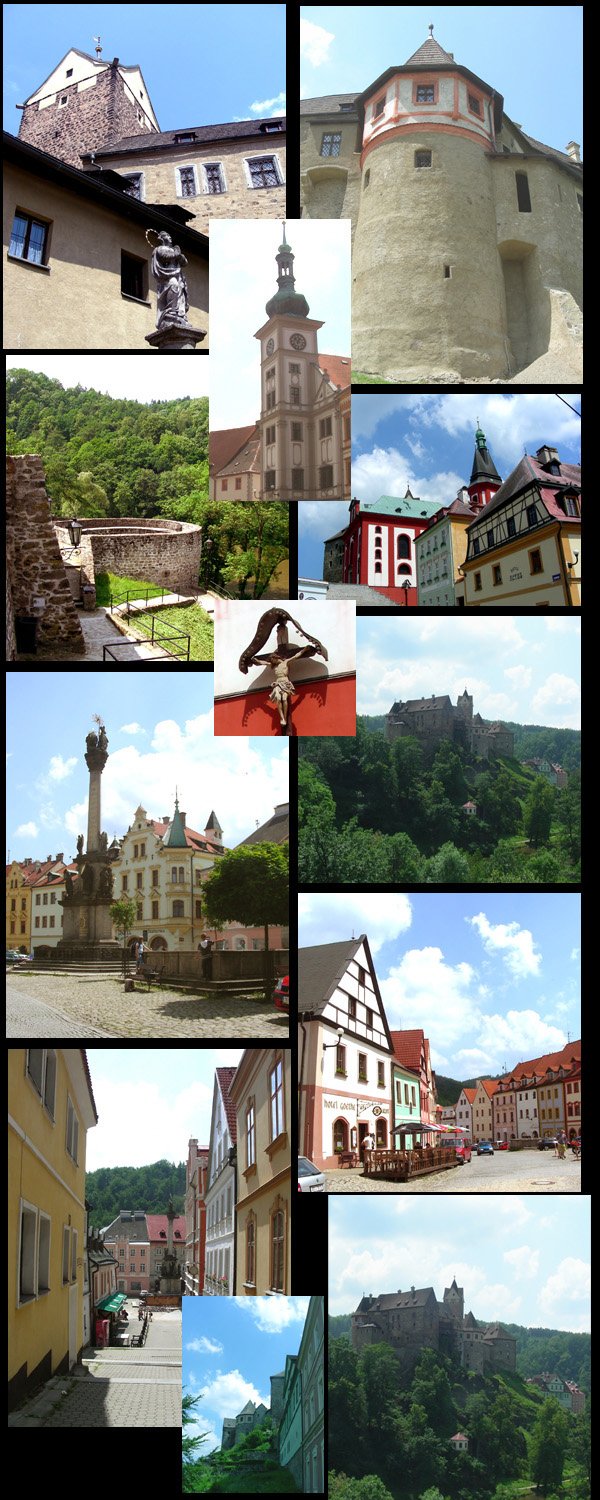
Loket Castle
The comprehensive restoration of the castle under Wenceslas IV was decisive for its present form. Of the original Romanesque buildings those preserved were mainly the extremely rare rotunda, the foundations of the castle's tower and those of the northern palace. The Margrave's House also originates from the reign of Wenceslas IV. Further reconstructions took place in the second half of the l5th century. The Šliks changed the southern palace into a great hall, and the eastern palace into the "Šlik archives." The castle suffered by being changed into a prison in the l9th century - most buildings were lowered by one stone and one of the oldest parts of the castle was completely destroyed.
In 1907, the Margrave's House was reconstructed to serve as the town museum, whose exhibitions included a collection of locally-made china. Later, exhibitions were also displayed in other rooms in the castle, but they had to be curtailed due to the building's poor condition, and finally the castle was closed to the public.
In 1992 the castle was handed over to the town of Loket, which has been looking for ways to make its appearance match its significance. In 1993 the castle was reopened to the public.
Johann Wolfgang Goethe: (Motto)
The poet visited the West Bohemia spa region frequently and with great pleasure. On three occassions he passed through the town without stopping, ten times he stopped there for a few hours. The dates of his visits are exactly recorded in the poet´s diareis, which also contain other comments and observations, e.g. the story told by an innkeeper of the "White Horse" of how Prussian troops passed through Loket after the battle of Jena, or describing the purchase of some Roman coins from a peasant. In his diary, Goethe often mentions percelain, the Svatos rocks and the Loket meteorite.
Goethe himself referred to August 23, 1823, his 74th birthday, as one of the happiest days in his life. Accompanied by Lady von Levetzow and three of her daughters, Goethe left Karlovy Vary at 7,00 a.m. for Loket where they arrived at 9,00 a.m.. In the course of the morning, they toured both the town and the castle to admire their beauties. After a festive lunch on the Schwarzenberg veranda, they then visited the city hall and a porcelain factory. After dinner, they returned to Karlovy Vary, where Goethe´s followers and admirers were awaiting them, and greeted the poet with a lengthy ovation.
One of the Lady von Levetzow´s three daughters, the 19year old Ulrike, had already caught Goethe´s eye two years earlier. During their further meetings, his interest increased . He even asked for her hand in marriage. They never married, however, Goethe expressed his feelings of disappointment and sadness in his famous "Elegy from Marienbad".
Goethe´s 1823 stay in Loket was his last - he neither returned to the town, not did he meet Ulrike, who lived, unmarried, to the age of 93.
"Today, we visited Ellenbogen (Loket), whose location is beautiful beyond description, and which can be admired from all sides as a topographical work of art."
J.W.Goethe
W from Prague, 2 hours to drive
Trip:
1)Loket medieval town and castle trip CWW9 - 6 hour round trip
Trips combinations :
2)Loket CWW9 + Manetin chateau CWW4 - 8 hour round trip
3)Loket CWW9 + Becov castle CWW7 - 8 hour round trip
4)Loket CWW9 + Kynzvart CWW6 - 10 hour round trip
5)Loket CWW9 + Plasy monastery CWW5 - 8 hour round trip
6)Loket CWW9 + Krivoklat castle CW1 - 8 hour round trip
7)Loket CWW9 + Nizbor ctystal factory CW3 - 8 hour round trip
8)Loket CWW9 + Tepla monastery CWW8 - 8hour round trip
9)Loket CWW9 + Karlovy Vary spa CWW2 - 9 hour round trip
10)Loket CWW9 + Marianske Lazne spa CWW1 - 9hour round trip
11)Loket CWW9 + Plzen
brewery(SWW1) - 9hour round trip
12)Loket CWW9 + Karlovy Vary spa CWW2 + Moser glassworks CWW3 - 10hour round trip
13)Loket CWW9 + Marianske Lazne spa CWW1 + Karlovy Vary spa CWW2 - 11hour round trip
14)Loket CWW9 + Marianske Lazne spa CWW1 + Karlovy Vary spa CWW2 + Moser glassworks CWW3 - 12hour round trip
15)Loket CWW9 + Marianske Lazne spa CWW1 + Ostroh CWW10 - 12hour round trip
16)Loket CWW9 + Marianske Lazne spa CWW1 + Plasy Monastery CWW5 - 12hour round trip
17)Loket CWW9 + Marianske Lazne spa CWW1 + Becov chateau CWW7 - 12hour round trip
18)Loket CWW9 + Marianske Lazne spa CWW1 + Loket and Cheb town CWW9 - 12hour round trip
19)Loket CWW9 + Becov chateau CWW7 + Marianske Lazne spa CWW1 - 12hour round trip
20)Loket CWW9 + Marianske Lazne spa CWW1 + Kynzvart town and spa CWW6 - 12hour round trip
21)Loket CWW9 + Karlovy Vary spa CWW2 + Moser glassworks CWW3 - 12hour round trip
22)Loket CWW9 + Karlovy Vary spa CWW2 + Ostroh CWW10 - 12hour round trip
23)Loket CWW9 + Karlovy Vary spa CWW2 + Plasy Monastery CWW5 - 12hour round trip
24)Loket CWW9 + Karlovy Vary spa CWW2 + Becov chateau CWW7 - 12hour round trip
25)Loket CWW9 + Karlovy Vary spa CWW2 - 12hour round trip
26)Loket CWW9 + Karlovy Vary spa CWW2 + Tepla monastery CWW8 - 12hour round trip
27)Loket CWW9 + Karlovy Vary spa CWW2 + Kynzvart town and spa CWW6 - 12hour round trip
28)Loket CWW9 + Marianske Lazne spa CWW1 + Karlovy Vary spa CWW2 - 11hour round trip
29)Loket CWW9 + Plzen brewery CSWW1 + Karlovy Vary spa CWW2 + Moser glassworks CWW3 - 12hour round trip
30)Loket CWW9 + Plzen brewery CSWW1 + Ostroh CWW10 - 12hour round trip
31)Loket CWW9 + Plzen brewery CSWW1 + Plasy Monastery CWW5 - 12hour round trip
32)Loket CWW9 + Plzen brewery CSWW1 + Becov chateau CWW7 - 12hour round trip
33)Loket CWW9 + Plzen brewery CSWW1 + Loket and Cheb town CWW9 - 12hour round trip
34)Loket CWW9 + Becov chateau CWW7 + Plzen brewery CSWW1 - 12hour round trip
35)Loket CWW9 + Plzen brewery CSWW1 + Kynzvart town and spa CWW6 - 13hour round trip
Our popular tours are outlined on our web sites:
www.private-tours.net
www.private-tours.cz
jewish.tourstoprague.com
editatours@gmail.com