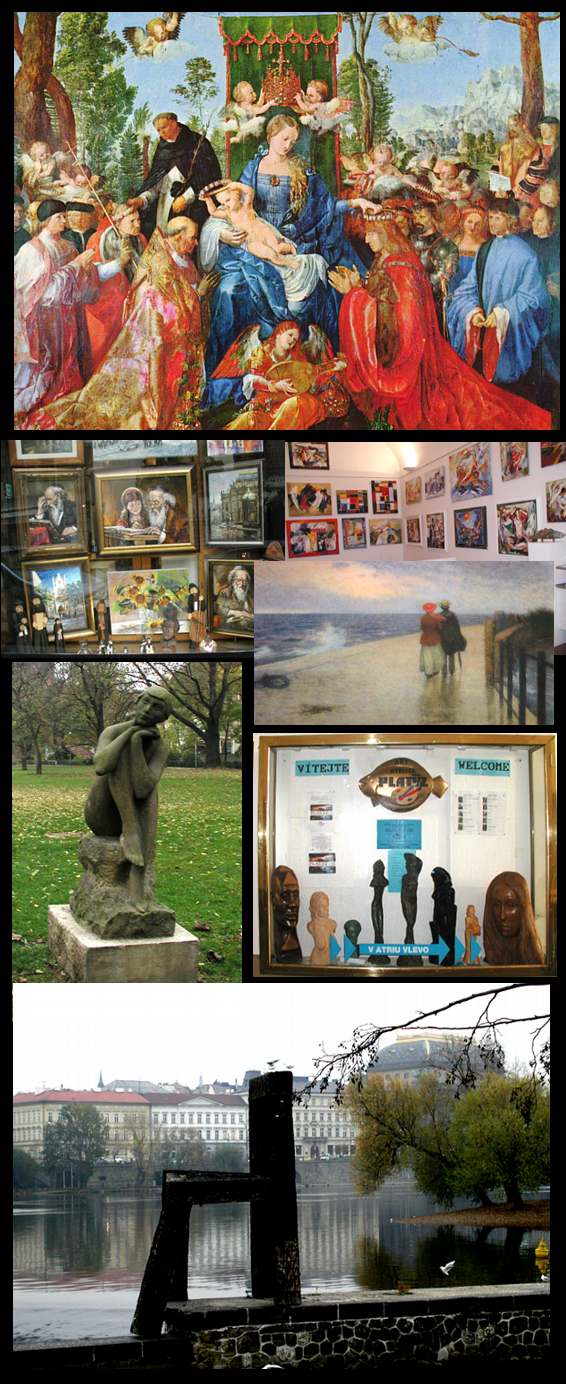
It is a walking or driven four hour tour.
This tour is usually
chosen by more sophisticated tourists interested in art.
The guide will take you to the best art museums of Prague where you can see both - the oldest art as well as the contemporary art.
It can be also combined with the art shopping tour.
4 HOUR TOUR
GUIDE and VEHICLE
or GUIDE ONLY
Tickets to attractions are not included in the tour price.
"At the turn of Rudolph II´s famous collection was the talk of all of Europe, but strangely enough, few were lucky to see it. It was kept at the Prague Castle, and was shown rarely by the monarch, sometimes he gave tours to those of whom he was especially fond, or in matters of diplomacy.
In general, Rudolph was a jealous owner, and access was limited, he fretted over many of the collection´s individual pieces. While Rudolph could visit from the comfort of his personal chambers any time he liked, only servants in charge of caring for the collection´s pieces were otherwise admitted, and they had an entance of their own.
The value of Rudolph´s collection was staggering, not only in temrs of its artistic and financial quality, but because of its oveall structure. The collection brought together many rare works of art and technology, valuable both for their sheer richness of materials, and valued for the genius of the artisans´skills.
To the detriment of Prague the collection was broken-up soon after Rudolph´s death in 1612, suffering the greatest damage during the Thirty Years War. The Swedes grabbed the greatest spoils, and today many of the collection´s pieces are scattered across Europe in museums in Germany, Holland and Austria..."
"A large part of Rudolph´s collection was made up of works by European masters, much of which was on display in the Spanish Hall of the Prague Castle. Titian, Leonardo da Vinci and Hieronymus Bosch, who was represented in full force with twenty paintings, and others like Pieter Breughel and his sons, rafael, Veronese, Corregio, Tintoretto, Lucas Cranach, Holbein, van Aachen, and Caravaggio were just a few of many renowned painters whose work enriched the overall collection. One of the most famous paintings to survive the sacking of Prague, which remains in the capital to this day, is the ROSARY CELEBRATION, a "window" to the Rudolphine era by Nuremburg painter Albrecht Durer. the paintings has a wonderful story that goes with it:
Durer was commissioned to create the painting as altar piece for the Church of St. Bartolomew during Fondaco dei Tedeschi in Venice. Rudolph became so enamoured with it he paid an enotmous sum for the original. Meanwhile, he commissioned an exact copy for the Iatlian church in order to make-up for their loss. In order to transport his new acquisition safely to Prague, Rudolph had it wrapped in cotton wool, rugs, and waxed linen, and in order to avoid abrasions during transport, teh painting was hung from a pole. It was bravely carried this way by men of great stamina, across the Alps,across Austria and finally Bohemia, to Rudolph II´s doorstep in Prague.
text - Jiri Kuchar - "Praha esotericka"
The Picture Gallery at Prague Castle is the oldest collection of paintings remaining in our lands. Their interesting destinies reflect the unsettling events from the 16th century until the present day leaving indelible marks across Central Europe: the renowned gallery from Emperor Rudolf II being made into a war prize, the new Habsburg collection either being removed from the Prague Castle premises or sold off elsewhere and the highly-valued canvasses serving merely as common decorations. The most valuable pieces from the protected historical set, together with Czech Baroque and 19th century paintings from new purchases, only started attracting much deserved attention in the middle of the twentieth century.
The history of the National Gallery in Prague started to be written on 5 February 1796 when a group of significant representatives of the patriotically oriented Czech nobility along with several middle-class intellectuals from the ranks of Enlightenment movement decided (to put it in period terminology) to "elevate the deteriorated taste of the local public."
The corporation, which received the title Society of Patriotic Friends of the Arts, then established two important institutions which Prague had, up until then, lacked: the Academy of Fine Arts and the publicly accessible Picture Gallery of the Society of Patriotic Friends of the Arts. The Picture Gallery became a direct predecessor of, what is today, the National Gallery in Prague. In 1902 the Picture Gallery was accompanied by yet another significant institution , the Modern Gallery of the Kingdom of Bohemia, as a private foundation of Emperor Franz Joseph I. The Modern Gallery then began to build its core collection of 20th century art.
In 1918 the Picture Gallery of the Society of Patriotic Friends of the Arts turned into a central art collection of the new Czechoslovak state. In 1919, Vincenc Kramář was appointed the Gallery's director and, in a short time, succeeded to turn the institution into a relatively modern and a professionally run gallery. In the complicated war period, in 1942, the funds of the abolished Modern Gallery were transferred under the management of the National (or more officially, Czech-Moravian Land) Gallery. A 1949 law regarding the National Gallery then legally "sanctified" this situation.
The National Gallery in Prague was established by and its activity is based on Law No. 148/1949 Coll. on the National Gallery in Prague.
The original idea that has lasted since the establishment of the National Gallery has been present in all the complicated peripeties of the Gallery's development: to elevate the nation's spirit through works of art. This ideal is considered the mission of the National Gallery even today.
In concordance with Law No. 148/1949 Coll. on the National Gallery in Prague, the National Gallery collects, records, maintains (on a permanent basis), professionally processes and makes publicly accessible, art works of painting, sculpture and graphic art, as well as works from the genre of, what is known as, "new media" of both home and foreign origin and professionally researches them. It is a museum in the sense as written in the provision of § 10, par. 6 of Law No. 122/2000 Coll. regarding the protection of the nature of museum collections and the modification of several other laws.
Medieval Art in Bohemia and Central Europe 1200–1550
A newly conceived exhibition of mediaeval and early Renaissance art was opened in November 2000 in the authentic environment of the first convent of the Poor Clares in Bohemia, probably founded in 1231 by St Agnes of Bohemia, the daughter of Přemysl Otakar I.
The first part of the exhibition on the first floor traces the development of Czech art from the panel paintings and sculptures of the mid-14th century (Master of the Vyšší Brod altar, Master of the Michle Madonna) and the "soft" style of Master Theodoric, to the paintings of the Master of the Třeboň Altar and those executed in the International style (St Vitus Madonna, St Peter of Slivice, variant of the Krumlov Madonna). While Bohemia and Prague were important European art centres during the 14th century and around the year 1400, in the 15th century they were more inclined to receive external stimuli (Master of the St George Altar, Master of the Puchner ark, Master of the Litoměřice altar). Bohemian and Moravian works from the 15th and early 16th centuries are confronted with works from other Central European regions with which Bohemia enjoyed close cultural ties at that time. The painting of the Madonna and Child by Master IW thus finds a common dialogue with a work on the same theme by Saxon artist Lucas Cranach the Elder. The venerable Master of the Lamentation of Christ from Žebrák is represented at the exhibition with key works documenting the high standard of carving in Southern Bohemia, whilst the influence of the Danube school (for example, the painting by Albrecht Altdorfer) is reflected in the work of Master IP.
European Art from Antiquity to Baroque
The exhibition in the Sternberg Palace was opened to all the art lovers after an overall installation in the years 2002 and 2003. The first part encompasses the works of art from the ancient Greece and Rome. The first floor exhibition halls further house the famous works of 14th - 16th century art that come from the Konopište Castle collection of Archduke Franz Ferdinand d´Este. It contains the works of older Tuscan masters (B. Daddi, Lorenzo Monaco), the works of Venetian school (Vivarini workshop) and the masterpieces of Florentine Mannerism (A. Bronzino, A. Allori). The icons on display offer the examples of works from the most of the important Mediterranean and East European centres.
On the second floor of the palace are exhibited the works of Italian, Spanish, French and Netherlandish masters from the 16th to the 18th century. The paintings by the most famous European artists such as Tintoretto, Ribera, Tiepolo, El Greco, Goya, Rubens and van Dyck can be found here. The collection of Flemish and Dutch masters dominated by works of Rembrandt, Hals, Terborch, Ruysdale and van Goyen is characterized by an extraordinary quality. The separate cabinet installed in the first half of the 19th century style reminds us of the famous collector and patron Josef Hoser, to whom the National Gallery owes for the essential part of its collection of old masters.
The ground floor houses the exhibition of German and Austrian art of the 16th to 18th century. Besides many masterpieces by e. g. Lucas Cranach or Hans Baldung called Grien one can find here one of the most famous works of the European painting The Feast of the Rosary by Albrecht Dürer. The painting was completed in Venice in 1506 and later it was purchased and trasferred to Prague by Emperor Rudolf II.
The exhibition is supplemented by chamber collections of arts and crafts and small sculpture of the period. The drawings and prints of the past centuries are on display in the cabinet of prints and drawings. On the walls and ceilings of the exhibition halls can be seen again the original murals exposed.
Art from the Rudolfine Era to the Baroque in Bohemia
On the three floors of the reconstructed building of the palace, the new permanent exhibition presents about 160 sculptural exhibits and 280 pieces of late Renaissance and Baroque painting, created in the territory of the lands of the Crown of Bohemia from the late 16th to the end of the 18th centuries.
As early as 2002, the interior disposition of the building of Schwarzenberg Palace and the distribution of the rooms designed for the needs of the permanent exhibition, „Baroque in Bohemia“ resulted in a decision to present the collections of sculpture and painting separately. The monumental stone sculptures „welcome“ the visitors when they enter the building. These include the renowned stone sculptures by Matthias Bernhard Braun from the attic of the Clam-Gallas Palace in Prague (1714-1716) and the two Angels from the hermitage near Lysá nad Labem, accompanied by the Moor figures from the gate of Kounice Castle, created by Maximilian Brokof. Three interconnected rooms present then en exhibition conceived according to traditional chronology and stylistic periods of the Early, High and Late Baroque. For the first time in such an extent, the adjoining space shows the best-quality surviving examples of everyday workshop practice of art studios, particularly those of the 18th century: sculptural and painting sketches, modellos, authorial and workshop replicas and copies.
The main installation on the 2nd and 1st floors of the palace is based on high-quality paintings, mostly known from the previous exhibition spaces in St George’s Convent. The collection was again conceived according to the accepted chronology in the sequence of stylistic cycles, spanning the time from the Late Renaissance, represented by the production of the artists active at the Prague court of Emperor Rudolf II, to the waning of Baroque culture in the late 18th century. The new exhibition includes all the great names of local fine arts of the 17th-18th centuries, with the emphasis on key figures. Well-balanced ensembles thus present the paintings by Hans von Aachen, Bartholomaeus Spranger, Roelant Savery, Michael Willmann, Johann Christoph Liška, Wenzel Lorenz Reiner, Anton Kern, Johann Peter Molitor, and Norbert Grund. The world of late Renaissance collections – cabinets of arts and curiosities – will be recalled in a partial reconstruction of such a collection with characteristic examples of small pictures and sculptures, and samples of the period crafts. The most important figures of Baroque painting in Bohemia – Karel Škréta and Peter Brandl – have intentionally been allocated prestigious spaces which will do justice to the qualities of both the ensembles of paintings, by right considered the gems of the Gallery’s Collection of Old Masters. One of the rooms on the 1st floor also presents in deliberate confrontation the portraits by Peter Brandl, and those by Johann Kupecký. Both painters explored similar (French and Dutch) sources of inspiration found in European portraiture. A specific form of „panel“ installation of paintings, with the principle of contrast and symmetry in mind, of the pendant pairs (compagnons) – be it landscapes, still lifes or figural compositions – is to recall the character of the period aristocratic picture galleries, most popular and wide-spread around 1700. It was precisely in the interiors of the city or country residences of local aristocrats that rare artifacts were also to be found, including cabinet sculptural pieces, made mostly of exclusive materials, such as bronze, ivory, tortoise-shell, marble and alabaster. Painting collections of 18th-century artists are accompanied by carefully selected samples of small-size carving of definitive character, coming from the Prague studios of Franz Ignaz Weiss, Karl Joseph Hiernle, Johann Anton Quitainer, and Ignaz Franz Platzer, installed in modern glasscases with perfect lighting.
19th-Century Art from Neoclassicism to Romanticism
The National Gallery’s Collection of 19th-Century Art has opened a new exhibition of 19th-century art in the newly-reconstructed Salm Palace on Hradčanské Square. The exhibition presents the most important examples of Czech painting and sculpture in the period from classicism to romanticism. The selected artworks, complemented by representative pieces on loan from important institutions and private collections, are arranged into several parts each focusing on a particular style, theme or artist. Czech art formed an inseparable part of the Central-European artistic sphere, and its points of departure, criteria and evaluation were closely connected with both the art scene and the institutions in Vienna and the artistic centres in Germany. For this reason, canvases by German and Austrian artists are an integral part of the exhibition. The character of the presented collection and the works’ small formats create a harmonious whole with the neoclassicist palace and the historical furnishing of its interiors.
Visitors can look forward to viewing the most important paintings by František Tkadlík, Antonín Machek, Josef Navrátil, August Piepenhagen, or a representative collection of paintings by members of the Mánes family highlighted by the works of Josef Mánes. Haushofer’s school of landscape painting is represented in works by Adolf Kosárek, Bedřich Havránek, Alois Bubák and others. Paintings by the students of Ruben’s school of historical painting will guide the viewer through both Czech and European history. Sections on Austrian and German painting include famous canvases by Caspar David Friedrich, Johann Christian C. Dahl, Carl Spitzweg, Christian Morgenstern, Carl Rottmann, Friedrich Amerling, and Ferdinand Georg Waldmüller, testifying to the mutual artistic relations within Central-European cultural space. The exhibition presents a broad selection of sculptures by Václav Prachner, Václav Levý, the brothers Josef and Emanuel Max and others.
The spaces on the ground floor of the Salm Palace are designed for temporary exhibitions. Here, visitors will find storage study room where they can participate in accompanying programmes organized by the education department. These programmes allow visitors to peek into the gallery’s backstage and study artworks on storage racks, the way they are kept in the storage at the National Gallery. A large space is dedicated to the education department’s interactive studio, the lecture hall and the art studio. Seniors can borrow light folding stools that will make their visit of our new exhibition more enjoyable.
The second part of the permanent exhibition entitled Art of the 19th Century from Realism to Modernism will open in spring 2015 on the 4th floor of the Veletržní Palace. The exhibition will introduce works by artists who went to Paris to study and to be inspired in this new European artistic centre of the second half of the 19th century. In addition to canvases by realists such as Karel Purkyně, Soběslav H. Pinkas and Viktor Barvitius, which have already been on display in the Veletržní Palace, visitors will see paintings by Antonín Chittussi, Jaroslav Čermák, as well as works from members of the so-called generation of the National Theatre, such as Václav Brožík, Vojtěch Hynais and Julius Mařák. The art of the late 19th century is represented by Maximilian Pirner, Beneš Knüpfer and Jakub Schikaneder. The exhibition concludes with canvases by students of Mařák’s school of landscape painting lead by the works of Antonín Slavíček.
International art of the 19th, 20th and 21st centuries
The international art collection of the National Gallery in Prague contains works by distinguished figures of the world of art. There is an extensive group of artworks by Austrian and German artists, among them Gustav Klimt, Egon Schiele and Oskar Kokoschka, as well as August Brömse and Emil Orlik. The expressive paintings of Edvard Munch and those of the Russian avant-garde artists Aristarkh Lentulov and Robert Falk are worthy of particular distinction. Spanish art comprises paintings by Joan Miró, Antoni Tàpies and Antoni Clavé.
The National Gallery’s famous French collection harks back to the 1920s when it was constituted with the aid of Czechoslovakia’s leading political and cultural personalities, including President Tomáš Guarrigue Masaryk himself and art collector and connoisseur Vincenc Kramář. The French collection holds many paintings by Auguste Rodin, Eugène Delacroix, the French landscapists Camille Corot, Camille Pissarro, Auguste Renoir and artists who paved the way for modern art: Paul Cézanne, Paul Gauguin, Vincent van Gogh and Georges Seurat. The Gallery also boasts unique Cubist paintings by Pablo Picasso, Georges Braque and artists who lived and worked in Paris: Marc Chagall, Pierre Bonnard and Maurice de Vlaminck.
Czech art from Modernism to the present
The story of Czech modern art begins in the mid-19th century. The art collection traces its development through the strongly represented artistic generations and individual artists, among them the chief exponents of Realism Viktor Barvitius and Karel Purkyně, the National Theatre Generation – Alphonse Mucha, Josef Václav Myslbek and Vojtěch Hynais, and artists espousing the Art Nouveau and Symbolism – Alphonse Mucha, Max Pirner and František Bílek. The founding generation of modern artists is represented by Antonín Slavíček, Jan Preisler and Max Švabinský. The National Gallery also houses the world’s most comprehensive collection of works by František Kupka that documents the painter’s advance from Symbolism to abstract art.
The story of Czech art continues with an installation of works by avant-garde groups – Osma (The Eight) and Skupina výtvarných umělců (The Group of Fine Artists), notably works by Emil Filla, Bohumil Kubišta, Antonín Procházka, Otakar Kubin (Othon Cubin) and Otto Gutfreund. Besides Cubist paintings, Cubism is also shown in architecture and design. The Gallery features rich holdings of paintings created by members of the group Tvrdošíjní (The Stubborn) – Jan Zrzavý, Václav Špála, Josef Čapek and Rudolf Kremlička.
Czech art produced after 1930 includes works by Jindřich Štyrský, Toyen, František Janoušek, Josef Šíma, Zdeněk Pešánek, Skupina 42 (Group 42), Zdenek Rykr, Alén Diviš, Mikuláš Medek and Zbyněk Sekal. Furthermore, the permanent collection also explores artistic movements from the 1960s up to the present: Art Informel, Action Art, New Sensitivity and postmodern art.
Contemporary art projects
The ground floor of the Trade Fair Palace, open to visitors all year round and free of charge, houses three periodical projects of contemporary art. These are:
The Moving Image Department: A space devoted to the moving image, presenting works of art via new media technology
Introducing: The small Presidential Salon as a place for the youngest generation of artists
Poetry Passage: the Functionalist staircase as a three-dimensional poem