

Antonin Dvorak´s MuseumThe greatest Czech composer.Order Tour Code: C B8 | |
Tour availability:


| |
|
| |
|
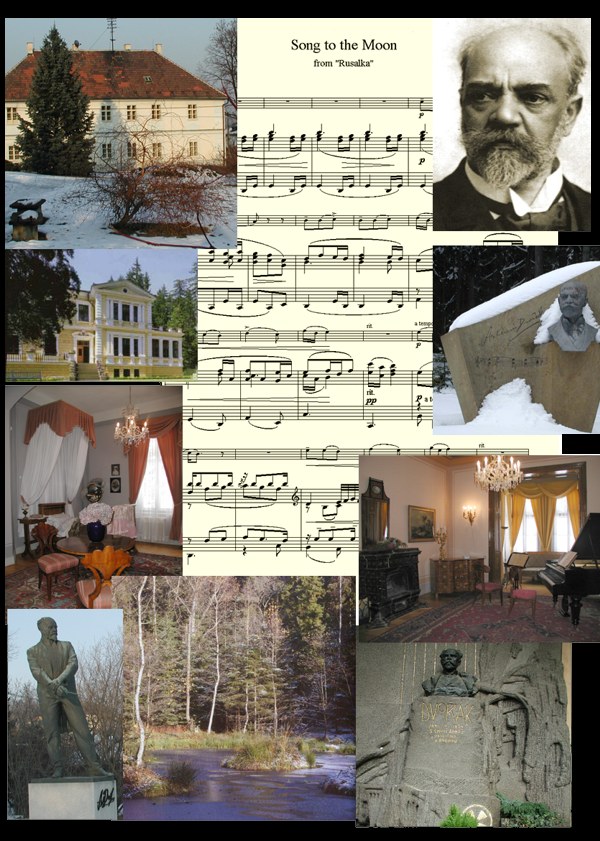
Antonin Dvorak spent in his country house about
20 years and more than 30 works were composed
here. Our guide will give you the explanation of
the exhibition in the museum situated in the
chateau of the Dvorak´s brother-in-law and will
show you the lake, that was an inspiration of his
most famous opera “Rusalka”.
The Neo-Renaissance stately residence at Vysoka u Pribrami, with its vast park, the nearby Rusalka´s Lake, the Villa Rusalka, and the scenic surrounding countryside, all served as sources of inspiration for the composer Antonín Dvořák (1841 - 1904), during more than two decades in his creative life. Opening Hours: April, May, June, September, October: Tuesday - Sunday 10 a.m. - 4 p.m. July, August: Tuesday - Sunday 10 a.m. - 5 p.m. Visiting just the Dvorak´s museum in Vysoka
would be a 5 hour round trip. NELAHOZEVES VILLAGE BIRTHPLACE OF ANTONIN DVORAK AND SURROUNDINGS THAT INFLUENCED HIM It is necessary to make a reservation in advance of seeing the house where Antonin Dvorak was born and grew up.His father Frantisek Dvorak was the butcher and run the local pub. You can see the church of St. Ondrej (Andrew) where Antonin Dvorak was baptised. It stands just opposite the family house of Dvorak. It was also this church where Antoni Dvorak played his first violin solo in 1854.Antinin Dvorak was nine years old in 1850 when the railway from Prague to Lovosice was built, the track passed through Nelahozeves, he watched the building of this railway with interest and listened to the tales told by the construction workers in the father´s pub. Besides the road, the Bohemian paddle steamer also provided a transport link with Prague. Nelahozeves was a frequent destination for excursions made by Prague residents. You can pass the Bohemian villages where was born Dvorak´s mother, villages where Antonin Dvorak played as the child during the pilgrimage under the direction of Dvorak´s first teacher of music. You can see the chateau Veltrusy where young Antonin Dvorak played in a band of his teacher Stepan Benda. You can also pass the village Zlonice where Dvorak lived in the house of his uncle and where the young Antonin Dvorak continued as apprentice butcher. There is a beautiful baroque church in Nelahozeves where Antoni Dvorak played on the organ. He used to play to Budenice chateau in the chamber orchestra. You can see the local cemetery where survived the graves of Antonin Dvorak´s uncle and teacher. In the year 1856 Antonin Dvorak became a butcher and in that year his father send him to Ceska Kamenice so as he could perfect his knowledge of German. He attended the school there and startetd to compose. In August he returned to Zlonice village where good news awaited him, At the intercession of his teacher Antonin Liehman and his uncle Zdenek and the local noble family of Kinsky, it was decided that he should go to study at the organ school in Prague. To see just Nelahozeves village and to drive around the places that influenced Antonin Dvorak when he grew up is a 4 hour round trip. It is possible to combine seeing both of places in one day and to stop also in Prague in the National Cemetery where Antonin Dvorak is buried. Nelahozeves and Vysoka museums of Antonin Dvorak and visiting the Prague cemetery where Dvorak is buried. | |
| |
| |
|
Dvorak, born in a Bohemian village, where his father was an inn-keeper and butcher, followed Smetana as the leading exponent of Czech musical nationalism, firmly within the classical traditions of Central Europe. His early musical training was followed by employment for some years as a violist, for a time under Smetana, and then, with the positive encouragement of Brahms, by a life primarily devoted to composition. Dvorak won recognition abroad and rather more grudging acceptance in Vienna. Between 1892 and 1895 he spent some time in the United States of America as director of the new National Conservatory, a period that brought compositions that combine American and Bohemian influence. At home again he was much honoured, resisting invitations from Brahms to move to Vienna in favour of a simple life in his own country. In 1894, Dvorak returned home and for the last ten years of his life he continued to compose. the Czechs honored him as their elder statesman of culture and the Austrian government made him a senator. At the end of his life Dvorak was in serious financial straits as he had sold his many compositions for so little he had nothing to live on. He died in 1904, shortly after the first performances of his last opera, Armida. |
editatours@gmail.com